The essence of life, which is given in the
Bhagavad-gita
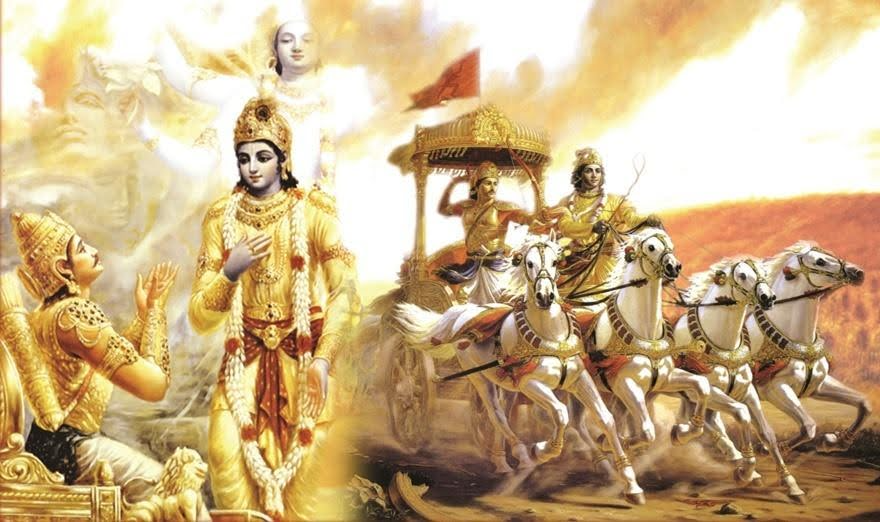
From Srila Bhaktivinod Thakur’s Rasikaraïjana
___________
Bg. 2.1 – Saïjaya said to Dhåtaräñöra: Seeing Arjuna become overwhelmed with compassion, his eyes full of tears and his mind overcome with grief Madhusüdanah (Kåñëa) spoke the following words.
Bg. 2.2, 3 – The Supreme Personality of Godhead said: O Arjuna, in the hour of crisis from where these lamentations have come upon you? This will not lead you to higher destination but to infamy.
Bg. 2.4, 5 – Arjuna said to Lord Kåñëa: O Madhusüdana! How can I counter-attack my worshipable elders like (Grandfather) Bhéñma and Dronächarya with my arrows? It would be better to live by begging, than to live at the cost of their lives. Though they are yearning for worldly-gains, they are our superiors. If they are killed in the battle, then everything that we may enjoy will be tainted with blood.
- As per the consciousness acquired due to the reactions of one’s past lives’ activities, he gets a particular type of material body and gets inclined to a particular type of prescribed duty such as brähmaëa (the intelligent class), kñatriya (the administrative/warrior class), vaiçya (the producer/trader class) or çüdra (the laborer class). By performing one’s prescribed duty with pure heart i.e., without any negligence and without any tinge of ulterior motivation by keeping the Supreme Lord at center, he never incurs sin rather he progresses towards perfection. [Note: The producer class means farmer and manufacturer]
Bg. 2.6, 7 – I am unable to understand which one is better – conquering them or being conquered by them? I got completely bewildered about my prescribed duty because of my miserly weakness and I have lost altogether my composure. In this situation, I am asking You for certain which one is better for me and taking the complete shelter of You as a surrendered disciple. Please instruct me.
1
Bg. 2.8 – I am not able to find any mean to drive away this grief, which is totally exhausting my senses. This cannot be dispelled even if I win a prosperous and unrivaled kingdom like demigods.
Bg. 2.9, 10 – Speaking thus Guòäkeçaù (Arjuna) said, “O Govinda! I shall not fight”, and he became silent. At that moment the Supreme Personality of Godhead, smiling in the midst of both the armies, spoke the following words.
Bg. 2.11 – The Supreme Personality of Godhead said: Although you are speaking like a learned person, you are lamenting for something not worthy of grief. One who is learned, laments neither for the living nor for the dead.
Bg. 2.12 – Undoubtedly never was there a time when I did not exist, nor you or all these kings, and never in the future will any of us cease to be.
- The living being (soul), which is forced to reside in the material body never dies; only the material body takes repeated birth and dies.
Bg. 2.13 – 38 – As the embodied-fallen-conditioned living being continuously transmigrates in the current material body from the childhood to youth and to the old age, similarly at the time of death it transmigrates into another material body. One who is learned, does not get bewildered by such a change.
- The fallen conditioned living being is forced to accept a temporary material body one after another till he achieves perfection. After achieving perfection, he goes back to his original home, the spiritual world. [Note: This material world in which we are living now is like a school, which educates us through the process of repeated birth and death based on our own actions and its reactions. That’s why this material world is called mrityu-loka, the place of death.]
2
Bg. 2.39 to 41- I have been explained to you till now in terms of säìkhya-yoga (the analytical study of ‘the cause and the effect’ of activities). But, now onwards I am going to explain to you in terms of ‘How to perform activities without having any desire for fruitive results’. On this path even a little advancement can save oneself from the most dangerous fear of material existence.
Bg. 2.42 to 44 – Whoever’s mind is too attached to sense enjoyment and heavenly opulence, the firm determination for pure devotional service does not take place in his heart. [Note: Performing one’s prescribed duties, without any negligence and without any tinge of ulterior motivation, by keeping the Supreme Lord at center which eventually leads him to love of God – is the most effective and practical path to achieve the ultimate goal of life. – Srila Bhaktivinod Thakur’s Rasikaraïjana 3.7, 3.19, 3.33]
Bg. 2.45, 46 – Vedas, in general, deal with the subject matter of three modes of material nature i.e., the subject matter of action and its reactions. You be transcendental to them and always be situated on the platform of pure devotional service, and always be free from dualities and anxieties for gain & safety, O Arjuna – thus, you always be established in the self.
- The three modes of material nature is the (divine) external energy of the Supreme Lord, which governs us at every step of our life as per the reactions of our own past activities. Under the spell of these three modes whatever activity we perform determines the level of our consciousness and finally, at the time of death, whatever level of consciousness we may have accordingly we receive our next material body; either it may be a higher or lower form of human life or it may be any other form out of 84 lakhs species. [Note: In the Padma Purana it is mentioned that there are 84 lakhs of varieties of material bodies, out of which 9 lakhs varieties are the aquatic bodies, 20 lakhs varieties are the bodies of trees, 11 lakhs varieties are the bodies of insects, 10 lakhs varieties are the bodies of birds, 30 lakhs varieties are the bodies of animals and 4 lakhs varieties are the bodies of humans.]
3
Bg. 2.47 – O Arjuna, you only have the privilege to perform your prescribed duties but you do not have any privilege to enjoy it’s results (i.e., you can utilize them only for your needs; not for your sense enjoyment). You should never become attached to the results of your labor, for they are very much controlled by the three modes of material nature based on the reactions of your own past activities. Also, you should never become attached to not performing your prescribed duties.
- The fallen conditioned living being, being bewildered by the influence of false ego, thinks himself the doer of his activities. But, in reality, those are performed by the three modes of material nature based on the reactions of his own past activities. – Bg. 3.27
Bg. 2.48 to 53 – O Dhanaïjaya. keep all the materialistic fruitive activities at far distance by performing your prescribed duties sincerely and devotedly without any negligence and without any tinge of ulterior motivation. One who wants to enjoy the end results of his labor is miser i.e., he utilizes his most valuable human form of life like a miser.
Bg. 2.54 – Arjuna inquired: O Keshava! What are the behaviors of those whose mind and intelligence are thus fixed?
Bg. 2.55 – The Supreme Personality of Godhead said: O Pärtha, when one gives up his desires for enjoying the worldly-pleasures altogether, and his mind finds satisfaction in the self alone, he is said to be fixed firmly in pure consciousness.
Bg. 2.56, 57 – As long as the fallen conditioned living being possesses a material body, he has to experiences the dualities of material existence like happiness and distress, good and bad, success and failure (due to the reactions of his own past activities). Those who do not get agitated by the good and bad effects of these dualities are said to be fixed firmly in perfect knowledge.
4
Bg. 2.58 to 61- As a tortoise retracts its limbs within its shell, similarly one who is able to retracts his senses from its gratifying objects is said to be fixed firmly in perfect consciousness.
- In the Çrémad-Bhägavatam it is mentioned as follows – the four most detestable sinful activities performed for one’s sense enjoyment are meat eating, intoxication, illicit sex (i.e. relationship outside marriage) and gambling (i.e. earnings through improper means or easy earnings).
Bg. 2.62 to 70 – As the ever-full-steady-ocean never gets disturbed by the incessant flow of rivers, similarly when one does not get disturbed by the incessant flow of his desires (which occurs because of the reactions of his own past activities) – he alone can attain peace; not one who strives to satisfy them.
Bg. 2.71, 72 – After giving up one’s desires for enjoying the worldly-pleasures, he who lives without any sense of proprietorship and false ego he alone attains real peace. If one is thus situated even at the end moment i.e., at the time death – he attains the supreme destination.
5
Important Verses:
O Pärtha, as I am the Supreme Lord there is no prescribed duties assigned for Me within all the three planetary systems yet I Myself get engaged carefully in all of My prescribed duties. (Bg. 3.22)
Arjuna inquired: O Värñëeya! What actually is inducing one to indulge in sinful activities even unwillingly as if he is engaged by force? (Bg.3.36)
The Supreme Personality of Godhead said: Certainly it is lust, O Arjuna, which is attained by the contact of mode of passion (which is acquired from the reactions of one’s own past activities). (Bg. 3.37 & 41)
Sacrifice (through one’s varna i.e., through one’s occupation), charity (through one’s ashram) and austerity performed for spiritual upliftment (through one’s sädhana) are not to be given up. Infact, sacrifice, charity and austerity performed for spiritual upliftment can even purify the great souls but they should be performed without any expectation of results as a matter of responsibility, O Pärtha, this is My final opinion. (Bg.18.5-6) [Note: As the Supreme Personality of Godhead Himself says here (this is his final opinion) this is the essence of entire Bhagavad-gita.]
The Supreme Personality of Godhead said: Whether you heard My words with an attentive mind, O Pärtha? Whether your ignorance is now dispelled, O Dhanaïjaya? (Bg. 18.72)
Arjuna said: Now, my illusion has gone and I have regained my memory by Your mercy. Now, I am firmly situated and free from all doubts and prepared to act according to Your instructions, O Achyuta! (Bg. 18.73)
Wherever there is Yogeçvaraù (Kåñëa, the Supreme Personality of Godhead) and wherever there is Dhanur-dharaù (Arjuna, the pure devotee) certainly there will be all-opulence, victory, extraordinary power and truthfulness. (Bg. 18.78)
6
Conclusion: (as per Bg. 18.5-6)
Eventhough one’s prescribed duties can be many but still they can be categorized into three.
- Varna related prescribed duties: (occupation related)
- Such as Brähmaëa, Kñatriya, Vaiçya or Çüdra. [Doctor, Engineer, Farmer, Teacher, Administrator, Warrior, Lawyer, Manufacturer, Trader, Laborer, etc., as per the context of modern civilization.] (It is performed by us with the help of the body)
- Ashram related prescribed duties: (family related)
- Such as the prescribed duties related to parent, children, parents-in-law, saintly persons, inter dependent living beings i.e. all the living beings, etc. (It is performed by us with the help of the body)
- Austerity performed for spiritual upliftment related prescribed duties (Sädhana)
- As per the level of one’s consciousness, the platform of his sädhana varies: viräö-rüpa, säyujya, sälokya, särñöi, särüpya, sämépya, çänta, däsya, sakhya, vätsalya, çåìgära and çåìgära-audärya. [The most easiest and the most simplest form of sädhana for this yuga i.e., the kali-yuga for all is singing congregationally the holy names of the Supreme Lord (at home (out of unlimited attachment like the inhabitants of Vrindavan), which is explained elaborately in Çré Chaitanya Charitamrita – Hindi Version of Inner Essence of Çré Chaitanya Charitamrita).] (It is exclusively performed by us; not by body)
Hare Krishna Hare Krishna Krishna Krishna Hare Hare
Hare Rama Hare Rama Rama Rama Hare Hare